Madinat Dubai Al Melaheyah: Inside Dubai’s Working Waterfront District
Madinat Dubai Al Melaheyah, officially known as Dubai Maritime City, mixes ship repair, marine business, offices, waterfront property, and new residential development on one purpose-built peninsula.

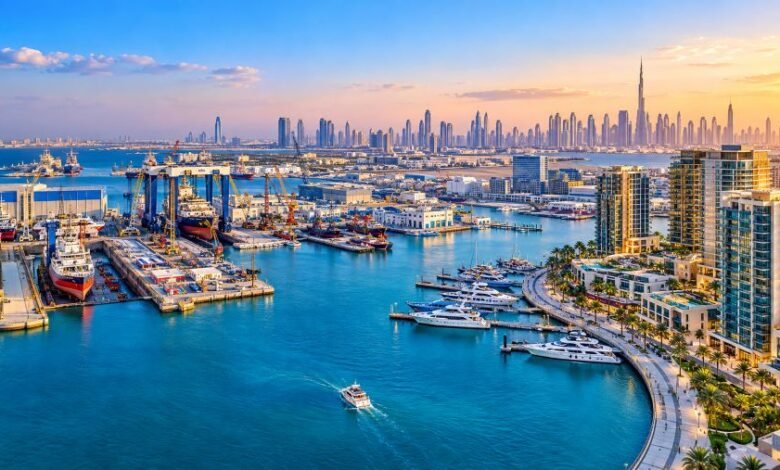
Madinat Dubai Al Melaheyah may look like an unfamiliar Dubai place name at first.
Basically, it is Dubai Maritime City.
The Arabic name is مدينة دبي الملاحية, while Dubai Maritime City, or DMC, is the official English name commonly used by the development.
This is no ordinary residential neighbourhood. Ships come here. Marine companies work here. Warehouses and repair facilities sit beside a growing collection of offices, apartment towers, waterfront plots, and public spaces.
The area covers 249 hectares and has separate industrial and commercial sections. Dubai Maritime City describes it as a purpose-built centre for marine business, ship repair, yacht services, engineering, commercial activity, and waterfront development.
Quick Facts About Madinat Dubai Al Melaheyah
| Fact | Details |
|---|---|
| Official English name | Dubai Maritime City |
| Arabic name | مدينة دبي الملاحية |
| Common abbreviation | DMC |
| Location | Dubai, United Arab Emirates |
| Development type | Maritime, industrial, commercial and residential |
| Total area | 249 hectares |
| Setting | Reclaimed waterfront peninsula |
| Main sections | Industrial Precinct and Commercial District |
| Ship lifts | 6,000-tonne and 3,000-tonne capacity |
| Ship-repair plots | 22 specialised plots |
| Warehouses | More than 200 |
| Phase 1 warehouses | 217 |
| Wet berthing | About 1,270 metres |
| Commercial Phase 1 | 28 mixed-use plots |
| Waterfront promenade | 3.5 km |
| Major 2026 office project | Maritime Business Centre 2 |
| Parent ecosystem | DP World |
| Maritime regulator | Dubai Maritime Authority |
What Is Madinat Dubai Al Melaheyah?
Madinat Dubai Al Melaheyah is the Arabic-transliterated name connected with Dubai Maritime City, a large waterfront district created around Dubai’s marine economy.
Its purpose is pretty clear.
Marine companies need access to the sea, workshops, storage, ship lifts, repair areas, offices, technical services, and berths. Dubai Maritime City puts many of those functions inside one dedicated location.
The district also has another side.
Its Commercial District is being built with residential towers, offices, hotels, retail space, public facilities, and waterfront property.
So DMC has two very different faces.
One handles ships.
The other is growing into a mixed-use waterfront community.
Dubai Maritime City’s official information puts the entire development at 249 hectares and describes predetermined industrial and commercial precincts within the site.
Where Is Dubai Maritime City?
Dubai Maritime City sits on Dubai’s coastline on reclaimed land near Port Rashid and Dubai’s established dry-dock area.
Its position gives marine businesses direct sea access while keeping the district close to older central parts of Dubai.
That location matters.
A shipyard needs proper marine access. An office district needs road access. Residential developers want waterfront land within reach of central Dubai.
DMC combines all three.
The peninsula setting also creates long stretches of waterfront, which explains why the Commercial District has attracted residential developers.
History of Dubai Maritime City
Dubai Maritime City has a formal legal history.
Law No. 11 of 2007 established Dubai Maritime City and the Dubai Maritime City Authority. The law set out plans to strengthen Dubai’s position in maritime services, vessel activities, ship and yacht work, marine research, and related sectors.
A later legal change came in 2023.
Law No. 3 of 2023 changed the name of the Dubai Maritime City Authority to the Dubai Maritime Authority. The authority has wider responsibility for maritime regulation across Dubai.
This distinction can confuse readers.
Dubai Maritime City is the physical district and marine-business location.
Dubai Maritime Authority is the public authority responsible for maritime regulation under Dubai law.
They are related names, but they are not the same thing.
Industrial Precinct
The Industrial Precinct is the working side of Madinat Dubai Al Melaheyah.
This area supports businesses involved in vessel repair, maintenance, yacht work, marine engineering, technical services, spare parts, storage, and related activities.
It is built for marine work.
DMC’s official material lists ship lifts, wet and dry berths, workshops, warehouses, industrial plots, showrooms, offices, and supporting infrastructure.
Ship Repair Plots
Dubai Maritime City currently lists 22 specialised ship-repair plots.
These plots have access to dry and wet berths, ship-lifting facilities, and the open sea.
Long-term industrial arrangements are available. DMC says qualifying plots can use a 25-year Musataha agreement, with the possibility of an extension.
That setup makes sense for businesses that need to build permanent marine facilities rather than rent a small office.
Ship Lifts
Large vessels cannot simply be pulled onto land.
Special lifting systems are needed.
Dubai Maritime City has two major ship lifts with published lifting capacities of 6,000 tonnes and 3,000 tonnes.
These facilities let marine companies move vessels from water to repair areas for inspection, maintenance, and technical work.
The numbers are big.
And the site keeps getting busier.
Wet and Dry Berthing
DMC provides wet and dry berthing for vessels undergoing marine work.
Its official facility information states that around 1,270 metres are dedicated to wet berthing.
Wet berthing means the vessel stays in the water.
Dry berthing places the vessel out of the water so crews can work on the hull and other parts that normally sit below the waterline.
Both matter in ship repair.
Warehouses and Workshops
Marine repair needs parts.
A lot of them.
Engines, equipment, tools, materials, fittings, and replacement components all need somewhere to go.
Dubai Maritime City says it has more than 200 warehouses spread across four zones. Phase 1 of the Industrial District contains 217 warehouses, with unit sizes starting from about 510 square metres, or 5,490 square feet.
The industrial zone is gated. DMC also states that security personnel, CCTV, and health, safety, and environmental requirements apply within the area.
Special yacht-repair workshops are available too.
DMC lists its largest yacht-repair workshop at around 2,522 square metres.
Commercial District
Now the picture changes.
The Commercial District is where the residential, office, retail, hotel, and waterfront side of Dubai Maritime City is taking shape.
Phase 1 contains 28 mixed-use plots.
DMC says about 86% of Phase 1 land plots have completed the sales process, while its current page lists 14 projects in development.
The area is open to property developers building residential and commercial projects.
That is why apartment towers are now an important part of the DMC skyline.
Is Dubai Maritime City Freehold?
The Commercial District includes freehold plots available for property development.
Dubai Maritime City markets these plots to developers planning residential or commercial projects.
Industrial land works differently.
Ship-repair plots can be offered under long-term lease structures such as Musataha agreements rather than the same setup used for residential development.
So the answer depends on which part of DMC someone means.
Residential and commercial development can involve freehold ownership.
Industrial marine land follows separate arrangements.
Waterfront Promenade
The Commercial District has another big feature: its promenade.
Dubai Maritime City says a 3.5 km waterfront promenade has been completed along the commercial area.
This changes how the neighbourhood works.
The industrial side needs docks.
The residential side needs walkable waterfront space.
Keeping those uses within different sections allows DMC to support both.
Community Facilities
DMC’s published Commercial District plan includes community facilities such as parks, mosques, RTA bus facilities, planned RTA marine stations, police facilities, and ambulance services.
There is one thing readers should understand.
A master plan and a finished neighbourhood are not always the same.
Dubai Maritime City is still seeing active development, so anyone choosing a home or commercial unit should check what has actually opened around that exact building.
That is much safer than assuming every planned facility is already operating.
Maritime Business Centre 2
One of the biggest recent commercial additions is Maritime Business Centre 2, commonly called MBC-2.
DP World opened the building on 22 May 2026.
The project cost AED 160 million and was completed in about 20 months. DP World said 78% of its space had been leased before opening.
MBC-2 contains 125 premium office units.
Published office sizes range from around 40 to 980 square metres.
The building gives DMC more dedicated office space for businesses working around maritime trade and related sectors.
Basically, marine operations are not limited to shipyards.
Companies need offices too.
Residential Development
Dubai Maritime City has become an active waterfront residential development zone.
Several private developers have acquired or developed plots within its Commercial District.
DMC’s own property page lists developers including OMNIYAT, Deyaar, DAMAC, Danube Properties, and other development partners.
Housing here is mainly apartment-led.
Waterfront towers suit the peninsula layout, and many new projects are being built within the Commercial District.
Still, project details change.
Construction stages change.
Handover dates can change too.
For that reason, buyers should check the developer’s latest information and official Dubai property records before relying on an old listing.
Record Vessel Activity in 2026
Dubai Maritime City remains a serious working marine centre.
That became very clear in July 2026.
On 28 July 2026, DMC recorded 52 vessels in its dry berths on a single day, its highest published single-day figure.
Dry-berth occupancy during July rose 22% year-on-year, while monthly vessel numbers increased from 188 in July 2025 to 202 vessels in July 2026.
Yachts and pleasure craft also showed stronger demand.
DP World reported an 88% year-on-year rise in dry-berth occupancy for that segment during July.
DMC is also working on more than 500 ship-cradle units for smaller vessels, with capacity for up to 60 small craft.
Those figures make one point clear.
The shipyard is active.
Largest Vessel Docked at Dubai Maritime City
Another record came in September 2026.
Dubai Maritime City docked the MT Cabri, a 145-metre tanker.
DP World described it as the largest vessel ever docked at the DMC Shipyard. The operation involved 38 staff members and took around three and a half hours.
The previous vessel-length record was 135 metres and had stood since 2020.
MT Cabri entered the facility for work that included a ballast-water treatment system, hull treatment, and other repairs.
This record gives a useful picture of DMC’s scale.
These are not small marina services.
Large commercial vessels can be handled here.
Business Activity in Dubai Maritime City
DMC supports many types of maritime companies.
Its services suit businesses working in areas such as:
- Ship repair
- Vessel maintenance
- Yacht repair
- Yacht manufacturing
- Marine engineering
- Marine technical services
- Spare parts
- Marine supplies
- Warehousing
- Workshops
- Shipping support
- Marine offices
- Vessel berthing
One older figure on DMC’s current website states that 280 businesses were registered in the zone in 2022, leasing 340 units and employing around 7,500 people.
That figure is useful historical context.
But it should not be presented as a confirmed 2026 business count.
Road and Site Access
Dubai Maritime City is connected to mainland Dubai by road.
Its coastal position places it near Port Rashid and established parts of old Dubai.
For people living or working there, private cars and taxis are practical choices.
The community is not built around an internal Dubai Metro station.
Anyone considering a home in DMC should check the exact route from the chosen tower to work, school, shopping, and public transport before signing a lease or buying.
Small distances on a map can feel different once road access is involved.
What Makes the Area Different?
The mix.
That is the simplest answer.
Many Dubai waterfront communities mainly focus on homes, hotels, beaches, retail, or tourism.
Madinat Dubai Al Melaheyah has a working maritime economy beside its newer property market.
Ships are repaired here.
Marine companies lease warehouses here.
Businesses use specialised industrial plots.
At the same time, residential towers and offices are rising along the commercial waterfront.
Few Dubai neighbourhoods combine these uses in the same way.
Things to Check Before Moving or Buying
Dubai Maritime City has attractive waterfront development, but buyers and tenants should check the exact location carefully.
Look at the building.
Then look around it.
Some parts of DMC are commercial. Others are industrial. Construction is still active across parts of the peninsula.
Check road access, nearby retail, parking, building completion status, public transport, local services, service charges, and the actual view from the unit.
Do not buy from a render alone.
Real conditions matter more.
Property prices should also be checked at the time of purchase because asking prices and recorded transactions can change quickly, especially in an area with many projects under construction.
Is Madinat Dubai Al Melaheyah the Same as Dubai Maritime City?
Yes.
Madinat Dubai Al Melaheyah is a transliterated form connected to the Arabic name مدينة دبي الملاحية, while Dubai Maritime City is the standard English name.
This also explains why map searches, property listings, and address databases may show slightly different spellings.
Readers may see:
- Madinat Dubai Al Melaheyah
- Madinat Dubai Almelaheyah
- Dubai Maritime City
- DMC
- مدينة دبي الملاحية
They point to the same Dubai district.
Final Thought
Madinat Dubai Al Melaheyah is one of Dubai’s more unusual waterfront districts.
It works hard.
Ships arrive for repair. Marine businesses use warehouses and workshops. Large vessels enter specialised facilities. Offices now sit beside the industrial zone, while new residential towers are adding another layer to the area.
The 249-hectare Dubai Maritime City is still growing, but its purpose is already clear.
It is both a maritime business centre and a developing waterfront community.
And in 2026, both sides are active.
Frequently Asked Questions
What is Madinat Dubai Al Melaheyah?
Madinat Dubai Al Melaheyah is another transliterated name for Dubai Maritime City, a waterfront district in Dubai built around maritime business, ship repair, commercial property, and residential development.
What is the Arabic name of Dubai Maritime City?
The Arabic name is مدينة دبي الملاحية.
How big is Dubai Maritime City?
Dubai Maritime City’s official website states that the development covers 249 hectares.
Is Dubai Maritime City residential?
Yes, partly. Its Commercial District includes residential, office, retail, hotel, and other mixed-use development. The site also has a large industrial maritime section.
Is Dubai Maritime City freehold?
Freehold plots are offered within the Commercial District for residential and commercial development. Industrial ship-repair plots use separate leasing arrangements.
What businesses operate in Dubai Maritime City?
The district is built for ship repair, yacht work, marine engineering, technical services, warehousing, marine supplies, vessel maintenance, and related business activities.
Does Dubai Maritime City have ship lifts?
Yes. Its industrial facilities include ship lifts with published capacities of 6,000 tonnes and 3,000 tonnes.
What is the largest vessel docked at Dubai Maritime City?
As of September 2026, the record is held by MT Cabri, a 145-metre tanker docked at the DMC Shipyard.
Does Dubai Maritime City have apartments?
Yes. Residential towers form part of the Commercial District, with several private developers building waterfront apartment projects.
No. Dubai Maritime City is the physical maritime and mixed-use district. Dubai Maritime Authority is the public authority responsible for maritime regulation in Dubai under Law No. 3 of 2023.