
Kunafa: Recipe, Ingredients, History, Chocolate and UAE Price
What kunafa is made of, who first made it, how to prepare it at home, how much a homemade tray costs in the UAE, and why chocolate kunafa became famous.

Introduction
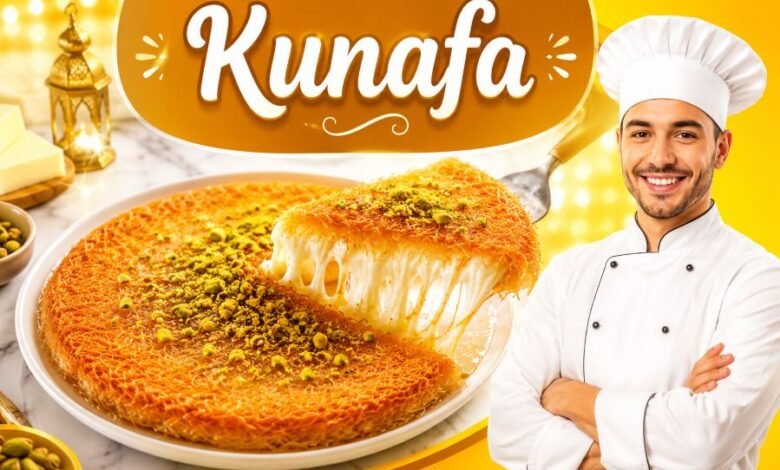
Kunafa is a famous Middle Eastern dessert made with crisp pastry, soft cheese or cream, sweet syrup, and pistachios. One of its best-known forms is strongly connected with Nablus, Palestine.
There is no verified historical record naming one person as the inventor of kunafa. The dessert developed over many centuries, and old written recipes existed long before today’s cheese-filled and chocolate versions.
Modern chocolate kunafa is different from the traditional dessert. It usually combines crispy kataifi pastry with pistachio cream, tahini, and chocolate.
In the UAE, a regular fresh serving often costs around AED 20–30. If you make a full cheese kunafa tray at home, the ingredients actually used can cost roughly AED 64–70, depending on the cheese, pistachios, and brands you choose.
Kunafa Quick Answer
If you only want the main answers, here they are:
| Question | Quick Answer |
|---|---|
| What is kunafa? | A Middle Eastern sweet pastry |
| What is it made of? | Kataifi pastry, ghee, cheese or cream, sugar syrup, and pistachios |
| Who invented it? | No verified individual inventor is known |
| Where is the famous cheese version from? | Nablus, Palestine |
| What cheese is commonly used? | Nabulsi and Akkawi |
| What is chocolate kunafa? | A modern mix of crispy kataifi, pistachio cream, tahini, and chocolate |
| Is Dubai chocolate traditional kunafa? | No, it is a modern kunafa-inspired chocolate |
| Fresh serving price in UAE | Often around AED 20–30 |
| Homemade tray cost in UAE | About AED 64–70 in ingredients used |
| Full shopping basket from scratch | Roughly AED 130–140 or more, with ingredients left over |
What Is Kunafa?
Kunafa is a sweet dessert enjoyed throughout the Middle East and in many other parts of the world.
The dish can have a crisp shredded pastry base or a softer, finer crust. Inside, there may be salty white cheese or cream. After cooking, sweet syrup is poured over it, and pistachios are often added on top.
The result is a dessert with several textures at the same time. The pastry is crisp, the filling is soft, and the syrup keeps it moist and sweet.
One of the most famous forms is called Knafeh Nabulseyeh, which is closely associated with the Palestinian city of Nablus.
What Is Kunafa Made Of?
A traditional cheese version usually has five important parts.
1. Kataifi Pastry
Kataifi is very thin, thread-like pastry.
It looks a little like fine noodles, but it is pastry rather than pasta. The strands are normally mixed with melted ghee before cooking so they become golden and crisp.
Some regional styles use a finer semolina-based crust instead.
2. Cheese
Nabulsi and Akkawi are among the best-known cheeses used in traditional preparations.
These white cheeses may be quite salty. For this reason, they are often soaked in fresh water before being added to the dessert.
Mozzarella is sometimes used as a substitute outside the Middle East because it melts well, although the taste is not exactly the same.
3. Ghee
Ghee gives the pastry a rich flavour and helps it become crisp and golden.
Butter may also be used in some home recipes.
4. Sweet Syrup
The syrup is usually made with:
- Sugar
- Water
- Lemon juice
- Rose water
- Orange blossom water
Different families and regions may use slightly different flavour combinations.
5. Pistachios
Crushed pistachios are commonly sprinkled on top.
They add colour, flavour, and a little extra crunch.
Complete Kunafa Recipe
This recipe makes one large homemade tray suitable for roughly 6–8 servings, depending on portion size.
Ingredients for the Kunafa
- 350–375 g shredded kataifi pastry
- About 100 ml melted ghee
- 450 g Akkawi cheese
- About 300 g Nabulsi cheese
- Around 50 g pistachio kernels for topping
- Extra ghee for greasing the pan
Ingredients for the Syrup
- 400 g white sugar
- 240 ml water
- ½ teaspoon lemon juice
- 1 teaspoon orange blossom water
- ½ teaspoon rose water
Step 1: Remove Excess Salt From the Cheese
Place salty Akkawi and Nabulsi cheese in a bowl of fresh water.
Leave it for around two to four hours.
Change the water several times during this period.
Taste a small piece before using it. The cheese should still have flavour but should not be strongly salty.
Drain it well and crumble or slice it into small pieces.
Step 2: Make the Sugar Syrup
Put the sugar and water into a saucepan.
Heat gently until the sugar dissolves.
Add the lemon juice and allow it to simmer briefly.
Remove the pan from the heat.
Add the rose water and orange blossom water.
Leave the syrup to cool while preparing the pastry.
Step 3: Prepare the Kataifi
Separate the pastry strands carefully with your fingers.
Pour the melted ghee over them.
Mix until the pastry is evenly coated.
Try not to leave large dry areas because the ghee helps create the golden, crisp texture.
Step 4: Build the Tray
Grease a round baking tray with a little ghee.
Spread the kataifi across the bottom.
Press it down firmly to form an even layer.
Add the prepared cheese over the pastry.
Spread the filling evenly but keep it slightly away from the outside edge.
Step 5: Cook Until Golden
Bake at a moderate oven temperature until the pastry becomes golden and the cheese is fully melted.
The exact cooking time depends on the size of the tray, thickness of the layers, and oven.
The important sign is the colour: the pastry should look deep golden rather than pale.
Step 6: Turn It Over
Place a large serving plate over the baking tray.
Carefully turn the tray upside down.
The crisp golden pastry should now be on top.
Step 7: Add Syrup and Pistachios
Pour some cooled syrup over the dessert while it is still hot.
Do not add all the syrup immediately if you prefer a less sweet result.
Sprinkle crushed pistachios on top.
Serve warm while the cheese is still soft.
How Much Does It Cost to Make Kunafa in the UAE?
Making a large tray at home can be cheaper per serving than ordering the same amount from a dessert shop.
Based on UAE supermarket prices checked in August 2026, this recipe has approximately the following ingredient cost.
| Ingredient Used | Approximate Cost |
|---|---|
| 350–375 g kunafa dough | AED 9–10 |
| 450 g Akkawi cheese | Around AED 21 |
| 300 g Nabulsi cheese | Around AED 15 |
| 100 ml ghee | Around AED 6 |
| 400 g sugar | Around AED 2 |
| 50 g pistachio kernels | Around AED 10 |
| Rose and orange blossom water used | Less than AED 1 |
| Lemon and small extras | Around AED 1–2 |
| Estimated total | Around AED 64–70 |
This estimate covers the amount of each ingredient actually used, not the price of every complete package you need to buy.
What If You Have to Buy Everything From Scratch?
Your supermarket bill will be higher if your kitchen has none of the ingredients.
You may need to buy complete packs of:
- Kunafa dough
- Akkawi cheese
- Nabulsi cheese
- Ghee
- Sugar
- Pistachio kernels
- Rose water
- Orange blossom water
- Lemon
Buying all of these packages can cost approximately AED 130–140 or more, depending on the brands and offers available.
However, you will not use all the ghee, sugar, pistachios, rose water, or orange blossom water in one tray.
The unused ingredients can be saved for another dessert.
Cost Per Serving
If a tray costing around AED 64–70 gives six to eight good portions, the ingredient cost works out to roughly:
AED 8–12 per serving.
This does not include electricity, gas, delivery charges, or your preparation time.
Is Homemade Kunafa Cheaper Than Buying It?
For a family or group, making a large tray at home can offer better value.
A single fresh serving in the UAE commonly costs around AED 20–30 at dessert shops.
At home, the ingredient cost may work out to around AED 8–12 per serving when one large tray is shared among six to eight people.
Buying from a shop is easier, while preparing it yourself gives you more control over the sweetness, amount of cheese, and size of each portion.
Who Invented Kunafa?
No reliable historical evidence identifies a single person as its inventor.
This is important because some websites repeat stories as if they are proven facts.
Old traditions sometimes connect a similar dessert with rulers from the early Islamic period. One well-known story links it with Mu’awiya I and Ramadan.
However, this story does not prove that Mu’awiya invented the dessert or identify the first baker.
Written recipes for related foods appeared in medieval Arabic cooking traditions many centuries ago.
The dessert also changed over time.
Early forms were not necessarily the same as the cheese-filled pastry sold today.
The most accurate answer is:
Kunafa has no verified single inventor. It developed through Middle Eastern cooking over many centuries.
Is Kunafa Palestinian?
The wider dessert has a long regional Middle Eastern history, so it is too simple to describe every version as coming from only one modern country.
However, Knafeh Nabulseyeh, one of the world’s most famous cheese versions, has a very strong connection with Nablus, Palestine.
Nabulsi cheese is an important part of this style.
Kunafa and closely related desserts are also common in Jordan, Lebanon, Syria, Egypt, Turkey, the Gulf, and other nearby regions.
So a clear answer is:
Kunafa is a historic Middle Eastern dessert, while the famous Nabulsi cheese style is strongly associated with Nablus, Palestine.
Why Is Nablus Famous for Kunafa?
Nablus became especially famous for its cheese-filled version.
One key reason is Nabulsi cheese.
It has a salty flavour that creates a strong contrast with the sweet syrup.
When combined with rich ghee, golden pastry, and pistachios, it creates the taste now recognised as Knafeh Nabulseyeh.
What Is Chocolate Kunafa?
Chocolate kunafa is a modern variation rather than the standard traditional recipe.
The popular chocolate style usually contains:
- Chocolate
- Crispy toasted kataifi
- Pistachio cream
- Tahini
- Pistachio pieces
It became particularly famous because of the worldwide Dubai chocolate trend.
Is Dubai Chocolate the Same as Kunafa?
No.
They share some ingredients and flavours, but they are different foods.
Traditional Kunafa
Traditional cheese kunafa normally contains:
- Pastry
- Ghee
- Cheese or cream
- Sugar syrup
- Pistachios
Dubai Chocolate
The famous chocolate style normally contains:
- Chocolate shell
- Pistachio cream
- Crispy kataifi
- Tahini
Traditional cheese and sugar syrup are normally not the main filling of Dubai chocolate.
The chocolate bar is better described as kunafa-inspired.
Who Created the Famous Dubai Chocolate?
The viral Dubai chocolate style became closely associated with Dubai-based FIX Dessert Chocolatier and its founder, Sarah Hamouda.
Its well-known chocolate combined pistachio filling with crisp kataifi and chocolate.
Videos showing the crunchy green filling helped the product become internationally famous.
This should not be confused with inventing traditional kunafa.
The original Middle Eastern dessert existed long before modern chocolate bars.
Easy Chocolate Kunafa Bar Recipe
You can also make a simple Dubai-style chocolate version at home.
Ingredients
- 80–100 g kataifi pastry
- 1–2 tablespoons ghee or butter
- 150–200 g pistachio cream
- 1 tablespoon tahini
- 250–300 g milk or dark chocolate
Method
Chop the kataifi into small pieces.
Toast it with ghee or butter until crisp and golden.
Allow it to cool slightly.
Mix the crunchy pastry with pistachio cream and tahini.
Melt the chocolate.
Spread a layer of chocolate inside a mould.
Allow it to become firm.
Add the pistachio and kataifi mixture.
Cover the filling with another layer of chocolate.
Chill until completely set.
The finished bar should have a firm chocolate shell with a creamy and crunchy centre.
Kunafa Price in UAE
There is no fixed price across the UAE.
The cost depends on:
- Portion size
- Cheese or cream filling
- Restaurant
- Emirate
- Brand
- Delivery platform
- Premium toppings
- Whether it is fresh or frozen
As of August 2026, a normal individual fresh serving can often cost around AED 20–30.
Small frozen portions may cost less.
Large family trays can cost considerably more, and premium products may reach AED 100 or above depending on size and seller.
Chocolate versions also vary greatly in price.
A small chocolate bar may cost around AED 20–30, while larger or premium pistachio-filled products can cost more.
Prices can change, so these figures should be treated as a current UAE guide rather than a permanent fixed rate.
Readers exploring Emirati businesses, destinations, services, and food-related information can find more UAE guides and local information in one place.
Frequently Asked Questions
What is kunafa made from?
It is commonly made with kataifi pastry, ghee, cheese or cream, sugar syrup, and pistachios.
What cheese is used in kunafa?
Nabulsi and Akkawi are two of the best-known traditional cheeses.
Can I make it with mozzarella?
Yes. Mozzarella is commonly used as an easier substitute because it melts well, but the taste is different from traditional Nabulsi or Akkawi cheese.
Where is Knafeh Nabulseyeh from?
It is strongly associated with Nablus, Palestine.
Who first made kunafa?
No reliable historical evidence identifies one individual as the first maker.
How much does homemade kunafa cost in UAE?
A large 6–8 serving cheese tray can cost roughly AED 64–70 in ingredients actually used, based on August 2026 UAE retail prices.
How much does one homemade serving cost?
For a six-to-eight-serving tray, the ingredient cost is roughly AED 8–12 per person.
How much does fresh kunafa cost in Dubai?
A regular individual serving commonly falls around AED 20–30, although prices differ between shops.
Is chocolate part of the traditional recipe?
No. Chocolate versions are modern variations.
What is inside Dubai chocolate?
The popular version normally has chocolate, pistachio cream, crunchy kataifi, and often tahini.
Is Dubai chocolate actually kunafa?
Not exactly. It is a modern chocolate product inspired by the pastry and flavours associated with Middle Eastern desserts.
Final Thoughts
Kunafa is much older than today’s viral pistachio chocolate trend.
Traditional forms developed across Middle Eastern cooking over many centuries, and no verified person can be named as the original inventor.
Nablus became especially famous for its cheese-filled Knafeh Nabulseyeh, while modern Dubai chocolate introduced the combination of crispy kataifi, pistachio, and chocolate to a new worldwide audience.
For someone cooking at home in the UAE, a large traditional cheese tray can cost around AED 64–70 in ingredients used, giving roughly six to eight servings.
That means a reader looking for the ingredients, full recipe, origin, inventor, chocolate version, UAE shop price, or home preparation cost can find the main answer in one guide.
